Much like physical health, financial health is a long-term game.
You might not notice a visible improvement day-to-day as you finish your workout or skip the expensive latte in favor of saving a few bucks… but over time, those actions compound.
Your cumulative short-term decisions add up to your long-term outcome. Your future self depends on your current self to make constructive choices that often forgo immediate gratification in favor of a better tomorrow.
So then why is it so damn hard for most people to save money or stick to a fitness routine?
First and foremost, it is because human nature works against long-term discipline. We’re wired for immediate gratification—our brains prioritize short-term rewards over distant, uncertain benefits. That’s why eating a cookie feels better than skipping dessert, and why spending on impulse is more satisfying than saving for retirement.
But more importantly, progress in both finance and fitness is slow and often invisible. When there’s no instant payoff, motivation fades. There is no feedback loop keeping people on track. There is no reward that helps align short-term behavior with long-term objectives.
That is, until recently.
Fitness has had its gamification moment: step counts, rings closed, streaks, etc.
These systems didn’t make exercise easy, but they made it visible. They tightened the feedback loop between effort and reward.
Finance, by contrast, has only just begun to move in this direction.
The Power of Rewards
Enter loyalty programs.
At their best, loyalty programs are the short-term nudges that tighten feedback loops and help generate long-term positive behavior.
From first principles, loyalty programs consist of four components:
An additional benefit for the client (cash back, points, perks), delivered through a specific mechanism (pricing, rewards platform, partnerships), given in exchange for a specific action (spending, saving, learning, engaging), that is intended to deepen a relationship or drive progress toward some longer-term objective.
The benefit is foundational. It is hard to incentivize without a meaningful incentive. Points are the default, but creativity matters: discounts, partner offers, experiences, contests, recognition. The key is that the customer feels tangibly rewarded for doing something you want more of.
Those benefits must also be delivered visibly. It is hard to stay motivated without a scoreboard. The tighter and more obvious the connection between action and reward, the stronger the behavioral effect. Waiting months for a vague benefit is far less powerful than seeing progress accumulate in real time.
Done well, loyalty programs translate abstract future value into concrete present feedback.
The Problem with Loyalty Today
Most loyalty programs in financial services are… fine. They exist. They work. But they are rarely strategic.
The best loyalty program in Canada is not run by a bank. It is run by the country’s largest grocer (PC Optimum).

By contrast, airline miles are valuable but boring. They reward spending, but rarely shape behavior in a deeper way. They are financial in nature, but not financial in purpose.
Which raises a natural question: why isn’t there an Apple Health for finances?
Part of the answer is structural. Financial data has historically been locked inside institutions. Without visibility, you cannot create meaningful feedback loops. Without feedback loops, you cannot build habit-forming systems.
Another part of the answer is incentive alignment. Traditional financial institutions make money when people transact and borrow. There is little built-in motivation to reward restraint, patience, or learning. Loyalty programs end up reinforcing activity rather than progress.
In other words: most financial loyalty programs are designed to retain customers, not improve outcomes.
Long-Term Success Requires Short-Term Nudges
If long-term success is the accumulation of many small good decisions, then the system should reward those decisions as they happen.
Financial incentives are powerful precisely because they translate abstract future benefits into immediate value. But in traditional finance, incentives are poorly matched to healthy behavior. They reward spending more than saving, debt more than discipline, convenience more than comprehension.
Loyalty points, however, are an unusual economic instrument. They are effectively a form of private currency: printed at low marginal cost, backed by a liability, and redeemable for perceived value. When deployed carefully, they can reshape behavior without requiring direct price competition.
This is where loyalty becomes strategic rather than surface-level.
Cyder: Loyalty as Infrastructure
Enter Cyder, a company built around the idea that loyalty can be strategic.
Rather than anchoring rewards to financial transactions alone, it treats loyalty as an engagement layer between credit unions, local businesses, and customers.
At a high level, Cyder connects financial institutions with nearby merchants and allows customers to earn rewards by supporting those businesses. The mechanism is simple, but the structure is interesting.
For the customer, it reframes spending as participation in a local ecosystem. Rewards are not just abstract points. They are tied to places they recognize and communities they live in.
For small businesses, it turns loyalty into distribution. Rather than running isolated punch cards or standalone programs, they gain access to customers already connected to their credit union or bank.
For credit unions, loyalty becomes more than a retention tool. It becomes a way to embed themselves in everyday life beyond etransfers and bill payments.
This is not loyalty as marketing. It is loyalty as connective tissue.
Why Credit Unions Rock
Credit unions do a lot of good in the world.
Their brand is rooted in community.
Their competitive advantage is not scale or sophistication, but proximity and trust.
A loyalty system that channels value toward local businesses reinforces that identity. It operationalizes the idea of “community-first” rather than merely advertising it and gives members a reason to engage beyond rates and fees.
In that sense, loyalty becomes a way to express a credit union’s purpose through customer behavior and there is something quietly powerful about aligning three incentives at once:
- Customers want to feel rewarded.
- Small businesses want more traffic.
- Financial institutions want deeper relationships.
Most systems optimize only one of these. Cyder links them all together.
This is what makes them interesting as a strategic example.
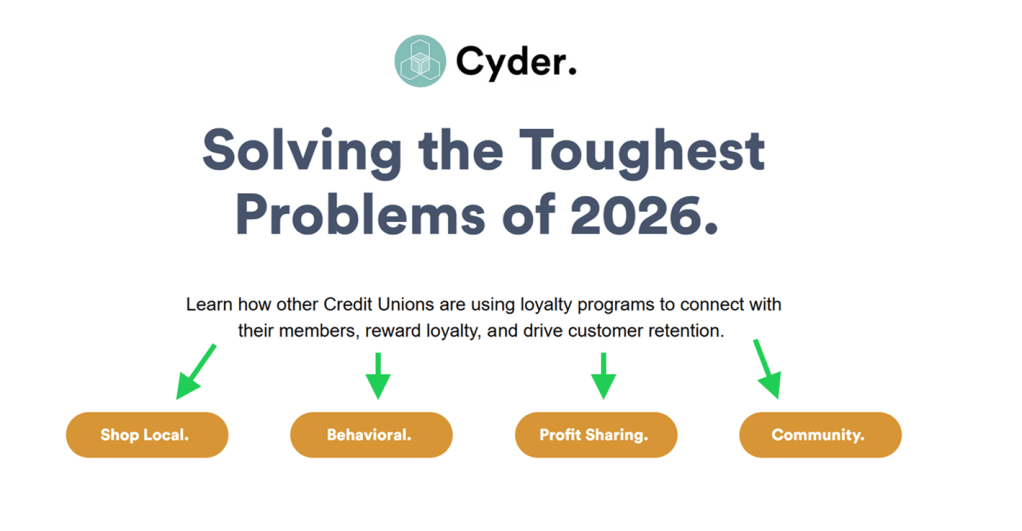
Cyder shows how loyalty can be used not merely to encourage repetition, but to shape patterns of economic activity.
In a world where financial services are increasingly commoditized, experience and engagement become differentiators. Loyalty programs are one of the few levers institutions still have to influence behavior without changing their core value proposition, which suggests that loyalty is not a side feature: it is an underappreciated competitive weapon.
Feedback Loops, Not Just Rewards
The deeper lesson is not about points. It is about feedback.
Systems change behavior when they make progress visible, immediate, and emotionally resonant. Fitness figured this out a decade ago. Finance is only beginning to.
Loyalty programs are one of the few tools available to tighten the loop between action and outcome in financial life. When designed thoughtfully, they can bridge the gap between what people know they should do and what they actually do.
The future of financial health will not be built on willpower alone. It will be built on systems that make good behavior easier, more visible, and more rewarding. And loyalty may be one of the most effective tools we have to get there.
 Paper & Blocks